
More Than Just a Name: The English vs. American Labradors Debate
The Labrador Retriever, a breed consistently ranked among the most popular dogs globally, is celebrated for its friendly demeanor and versatility. Yet, a fascinating divergence exists within the breed, often surprising prospective owners: the presence of two distinct types. While officially recognized as a single breed by organizations such as the American Kennel Club (AKC) and The Kennel Club (KC) in the UK, two distinct types are commonly referred to as the “English Labrador” (show line) and “American Labrador” (field line). This distinction isn’t an official breed classification but reflects differing breeding priorities—conformation shows versus working abilities like field trials.
The debate surrounding the English vs American Labrador highlights the breed’s adaptability and the impact of selective breeding on traits. Understanding these Labrador differences is crucial for anyone considering this beloved breed. This article aims to unravel the complexities of these two Labrador types, offering a comprehensive Labrador retriever comparison across their history, physical attributes, temperament, health, and breeding standards. Our goal is to provide clarity and assist you in making an informed decision about which Labrador type best suits your lifestyle.
Historical Context: Tracing the Lineage of Two Distinct Types
Origins of the Labrador Retriever: A Shared Ancestry
The history of the Labrador Retriever begins in Newfoundland, Canada, where their ancestors, the St. John’s Water Dogs, were indispensable companions to fishermen. These robust dogs excelled at retrieving from icy waters. In the early 19th century, British nobles brought these dogs to England, recognizing their exceptional retrieving abilities. The breed was formally recognized by The Kennel Club (KC) in the UK in 1903 and by the American Kennel Club (AKC) in 1917, establishing a shared foundational history for both types.
Divergence in Breeding: How Two Standards Emerged
The divergence into distinct “English” and “American” types largely stemmed from differing breeding goals in the United Kingdom and the United States. While both types technically conform to the same overarching breed standard, these differing priorities led to the observable differences in appearance and temperament.
- In the UK: Breeders primarily focused on conformation, aiming for dogs that excelled in the show ring and adhered to aesthetic breed standards. This focus led to the development of the more compact, stocky “English” type, which largely defines the modern English Labrador origin.
- In the US: Emphasis was placed on the Labrador’s working abilities, particularly for hunting and field trials. Breeders selected for high drive, endurance, and athleticism, resulting in the leaner, more agile “American” type. This pursuit of working performance is central to the development of the American Labrador.
Physical Differences: A Side-by-Side Comparison
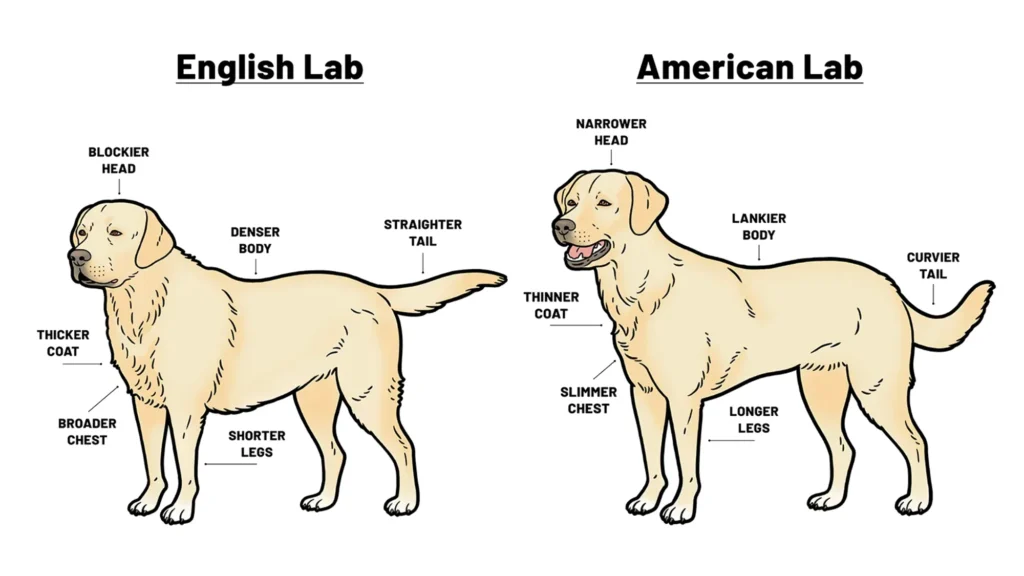
Physical characteristics offer the most immediate way to distinguish between English and American Labradors. Here’s a detailed comparison:

| Feature | English Labrador (Show Line) | American Labrador (Field Line) |
|---|---|---|
| Build & Stature | More compact, stocky, heavily boned, “barrel-chested.” Generally shorter but more substantial overall. | Leaner, more athletic physique, often appearing taller with longer legs and less dense bone structure. Built for agility and endurance. |
| Head & Muzzle | Broader, “blocky head Lab” with a fuller muzzle and a more pronounced stop. | Narrower head, longer and more tapered muzzle, and a less defined stop. More refined facial profile. |
| Coat & Tail | Slightly thicker and denser Labrador coat, aligning with their more substantial build. Characteristic dense, water-resistant double coat and strong “otter tail.” | Characteristic dense, water-resistant double coat and strong “otter tail.” Subtle variations are generally minor. |
| Average Height (Males) | 22-22.5 inches | 22.5-24.5 inches |
| Average Weight (Males) | 65-80 pounds | 60-75 pounds |
| Average Height (Females) | 21.5-22 inches | 21.5-23.5 inches |
| Average Weight (Females) | 55-70 pounds | 50-65 pounds |
Note: These are averages, and overlap exists, but they illustrate the typical physical distinctions.
Temperament and Personality: Beyond Physicality
Beyond physical traits, temperament and personality significantly differentiate the two Labrador types, impacting their suitability for various lifestyles.
Energy Levels and Drive: Couch Potato vs. Marathon Runner
- English Lab Temperament: Generally calmer and more laid-back, often content to be a “couch potato” after sufficient exercise. They possess ample energy for play but typically exhibit a lower overall Labrador drive.
- American Lab Personality: Defined by significantly higher Lab energy levels, intensity, and a stronger drive. Bred for demanding field work, they are “marathon runners,” requiring extensive physical and mental stimulation to prevent boredom and destructive behaviors.
Trainability and Work Ethic: Show Ring vs. Field Trial
Both types are intelligent and eager to please, making them highly trainable. However, their inherent drives lead them to excel in different areas:
- English Labradors: Often excel in obedience, conformation (the “working Lab vs show Lab” distinction), and therapy work due to their stable, biddable temperaments.
- American Labradors: With their intense drive and athleticism, are frequently chosen for competitive field trials, hunting, and high-energy dog sports where endurance and focus are paramount.
Suitability as Family Pets: Which One Fits Your Lifestyle?
Both types can be wonderful family pets, known for their friendly, loyal dispositions, embodying the “family dog Labrador” ideal. However, their energy levels are a key differentiator:
English Labradors, with their calmer nature, are well-suited for less active families or smaller living spaces, provided they receive regular exercise. American Labradors, conversely, require very active families committed to ample daily exercise, training, and mental engagement. Understanding the trainability Lab differences and energy needs is key for a harmonious household.
Working Dog Traits: Hunting, Service, and Therapy Roles
- American Labradors: Often preferred for demanding hunting and field work due to their exceptional stamina and retrieving instincts.
- English Labradors: Owing to their stable and calm temperaments, are frequently selected for service dog roles (e.g., guide dogs) and therapy work, where their gentle nature and focus are highly valued.
Individual dogs of either type can excel in various roles, but these are general tendencies.
Health Considerations: Common Ailments and Predispositions
Understanding breed-specific health predispositions is crucial for responsible Labrador ownership, regardless of type.
Shared Health Concerns: Hip, Elbow, and Eye Conditions
Common Labrador health issues affecting both Labrador types include:
- Orthopedic Conditions: Such as hip dysplasia Lab and elbow dysplasia Lab. These joint abnormalities can lead to arthritis and lameness, necessitating screenings by responsible breeders (OFA/BVA).
- Eye Conditions: Labrador eye conditions such as Progressive Retinal Atrophy (PRA) and cataracts are also prevalent.
- Other Genetic Concerns: Including Exercise-Induced Collapse (EIC) and Centronuclear Myopathy (CNM).
Genetic testing and regular veterinary check-ups are vital for all Labradors.
Type-Specific Health Notes: Are There Differences?
There is no significant scientific evidence suggesting unique, type-specific health predispositions for either English Lab health or American Lab health beyond general breed-wide concerns. However, their physical differences and activity levels can influence how these issues manifest. The athletic American type might be marginally more prone to certain athletic injuries if over-exercised or not adequately conditioned. The heavier English type could experience slightly more joint strain if allowed to become overweight. These are observations related to build and activity, not inherent genetic differences. Responsible breeding and proper care are paramount for both.
Breeding Standards and Registries: Influencing the Breed’s Future
The existence of two distinct Labrador types stems from differing interpretations of official breed standards Labrador by major kennel clubs.
The American Kennel Club (AKC) Standard
The AKC Labrador standard describes a “strongly built, very active” dog capable of fulfilling its purpose as a retrieving gun dog. While not explicitly differentiating types, U.S. breeders often interpret this standard to favor an athletic, agile build suitable for field work and performance events. This emphasis on functionality and sustained work shapes the “field line” or American type.
The Kennel Club (KC) (UK) Standard
The Kennel Club Labrador standard in the UK describes the Labrador as “strongly built, short-coupled, very active; giving the impression of a powerful and indefatigable animal.” UK breeders, particularly those focused on conformation, typically interpret this standard towards a more substantial, compact, and heavily boned dog, emphasizing aesthetic qualities for the show ring. This focus on a robust build is associated with the “show line” or English type, highlighting the “show Lab vs field Lab” distinction.
Impact on Breeding Goals and Phenotype
These differing interpretations profoundly influence Labrador breeding goals and the resulting phenotypes:
- Breeders aiming for conformation success select for “English” traits such as the blocky head and stocky build.
- Those focused on field trials prioritize “American” traits: high drive, athleticism, and retrieving instinct.
This selective breeding, guided by specific goals, has solidified the distinct appearances and temperaments seen today, even though both types adhere to the same official breed standard.
Which Labrador is Right for You? Making an Informed Decision
Choosing a Labrador requires an honest assessment of your lifestyle and expectations. Both types are exceptional, but their differing needs mean one might be a better match.

Assessing Your Lifestyle: Activity, Space, and Time Commitment
- Highly Active Lifestyle: If you lead a highly active life, enjoy outdoor adventures, and can commit to significant daily exercise (e.g., running, extensive retrieving), an American Labrador might be an excellent fit. They thrive on having a “job” and ample space.
- Calmer Home Environment: If you prefer a calmer companion, enjoy regular but less intense walks, and have a more relaxed home environment, an English Labrador might be more suitable. They adapt well to smaller spaces if their moderate exercise needs are met.
- Time Commitment: American Labradors demand more dedicated time for stimulation.
Considering Your Family Dynamics: Children and Other Pets
Both types are generally excellent with children and other pets. However, consider energy levels:
- The calmer demeanor of an English Labrador might be slightly more forgiving with very young children, reducing accidental bumps.
- An American Labrador’s higher energy requires careful management and training around small children to prevent accidental rough play.
Early socialization is crucial for both. When considering an English versus American Labrador for your family, think about the energy level you can realistically manage.
Prioritizing Traits: Appearance, Temperament, or Working Ability?
Your priorities should guide your decision:
- Appearance: If a specific “look”—the blocky head of an English Labrador or the sleek frame of an American Labrador—is paramount, that will influence your choice.
- Temperament: If a calm, stable temperament for a family companion or service animal is your main goal, an English type might be preferred.
- Working Ability: If you prioritize high drive, exceptional athleticism, and potential for demanding working roles, an American type is often the better match.
Remember that individual personalities vary, so observing the litter’s temperament is recommended to ensure a good Labrador lifestyle fit.
Conclusion: Celebrating the Diversity Within a Beloved Breed
Key Takeaways: Summarizing the Core Differences
The Labrador Retriever, a universally adored breed, exhibits a fascinating duality. This summary of Labrador breed comparison highlights the core distinctions:
- English Labradors: Are stockier, with broader heads and a calmer, more laid-back disposition, often excelling in conformation and therapy work.
- American Labradors: Are leaner, more athletic, and possess higher energy levels and drive, thriving in demanding working roles like hunting and field trials.
Both are intelligent, eager-to-please, and highly trainable, but their distinct characteristics cater to different lifestyles. Understanding Labradors beyond a superficial level is key.
The Importance of Responsible Breeding and Ownership
Regardless of your choice, responsible breeding and ownership are paramount. This involves:
- Seeking Responsible Breeders: Who prioritize health clearances (e.g., hip, elbow, eye) and temperament.
- Lifelong Commitment: To meeting your Labrador’s specific needs: adequate exercise, consistent training, proper socialization, a balanced diet, and lifelong veterinary care.
Celebrating the diversity within this beloved breed means appreciating each type’s unique qualities while ensuring every Labrador lives a healthy, fulfilling life through informed decisions and responsible practices.
Frequently Asked Questions
What are the main physical differences between English and American Labradors?
English Labradors are typically more compact, stocky, and heavily boned with a broader, “blocky” head and a fuller muzzle. American Labradors are leaner, more athletic, often appearing taller with longer legs, and have a narrower head and a more tapered muzzle.
Are English and American Labradors considered different breeds?
No, they are not officially different breeds. Both are recognized as a single breed, the Labrador Retriever, by organizations like the American Kennel Club (AKC) and The Kennel Club (KC). The terms “English” and “American” refer to distinct types or lines (show line vs. field line) that emerged due to differing breeding priorities.
Which type of Labrador has a calmer temperament?
English Labradors generally have a calmer, more laid-back temperament and lower overall energy levels, often content to be “couch potatoes” after sufficient exercise. American Labradors typically have significantly higher energy levels and drive, requiring extensive physical and mental stimulation.
Do English and American Labradors have different health concerns?
There is no significant scientific evidence suggesting unique, type-specific health predispositions. Both types share common Labrador health issues like hip and elbow dysplasia, and certain eye conditions. Differences in build and activity levels might influence how these issues manifest, but not their genetic prevalence.
Which Labrador type is better suited for an active lifestyle?
The American Labrador is generally better suited for a highly active lifestyle. Bred for demanding field work, they possess high energy, intensity, and drive, thriving with significant daily exercise, outdoor adventures, and mental stimulation. English Labradors, with their calmer nature, are better for less active families.