
The Labrador Retriever, celebrated for its loyalty, intelligence, and gentle nature, consistently ranks among the most beloved canine companions. While many picture the classic black, sunny yellow, or rich chocolate coats, the spectrum of Labrador Retriever colors extends far beyond these familiar shades. This comprehensive guide aims to unravel the full spectrum, distinguishing between officially recognized hues and intriguing, often debated, unofficial varieties.
More Than Just Black, Yellow, and Chocolate
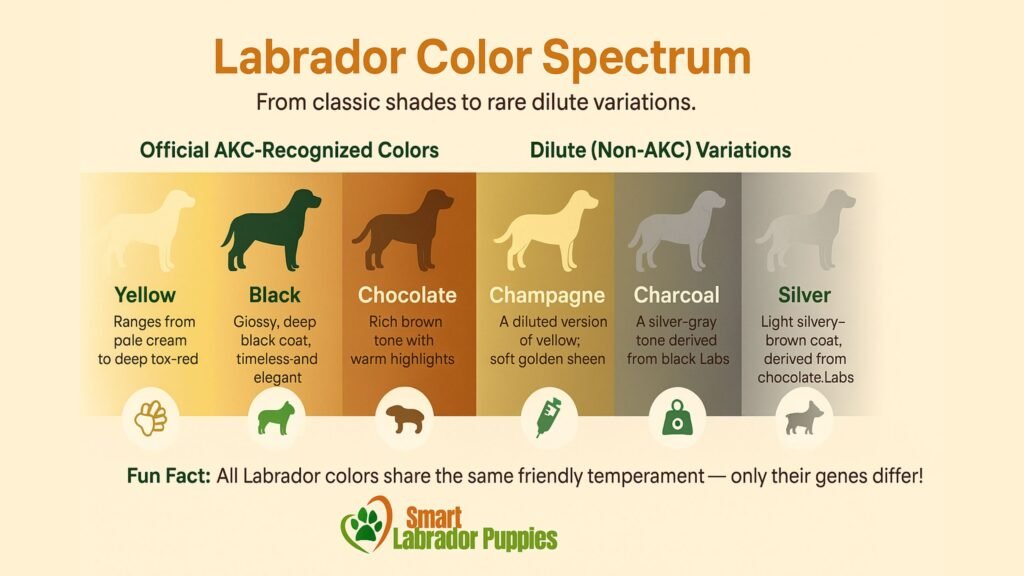
While the American Kennel Club (AKC) officially recognizes only three primary Labrador coat colors—black, yellow, and chocolate—the breed’s genetic makeup allows for a wider array. These official colors encompass various shades, from palest cream to deepest fox red within yellow, and milk chocolate to dark liver within brown. Beyond these, ‘dilute’ colors like silver, charcoal, and champagne also exist. These dilute variations are registered by the AKC as their closest standard color but carry a specific genetic marker. Understanding these differences is key to appreciating official Labrador colors versus unofficial Lab colors, and the breed’s full spectrum.
Key Distinction: Official AKC colors (Black, Yellow, Chocolate) vs. Unofficial/Dilute colors (Silver, Charcoal, Champagne) which are registered under their closest standard color but have distinct genetic origins.
Labrador Puppy Prices: What to Expect, Costs & Factors Explained
The Three Official Labrador Retriever Colors: A Deep Dive
For generations, the Labrador Retriever has been defined by its three core coat colors, each with distinct appeal and history, and meeting major kennel club breed standards globally.
Black Labradors: The Classic and Enduring Shade
The black Lab is arguably the most iconic and historically significant of all Labrador Retriever colors, often associated with the breed’s working origins. The solid black Lab embodies timeless elegance.
- Genetic Basis: Genetically dominant, black coloration requires at least one dominant ‘B’ allele (for black pigment) and at least one dominant ‘E’ allele (for pigment expression).
- Commonality: This makes black Labradors the most common, considered the quintessential, classic Labrador color.
- Temperament: There’s no scientific evidence that black Labrador temperament differs from other colors; it’s shaped by genetics, socialization, and training.
- Health: Similarly, black Lab health shows no inherent advantages or disadvantages tied to their black coat, depending primarily on responsible breeding.

Yellow Labradors: From Cream to Fox Red
The yellow Lab offers a delightful spectrum of shades, from palest, almost white Lab or delicate cream Lab, to rich golden hues, and deep, striking fox red Lab. All these yellow Labrador shades are genetically ‘yellow.’
- Genetic Basis: Resulting from a Labrador inheriting two recessive ‘e’ alleles at the E locus, which prevents black or brown pigment expression. The intensity of yellow is determined by modifier genes.
- AKC Standard: The AKC standard permits this wide range of yellow shades.
- Temperament: Myths about yellow Lab temperament are unfounded; personality is a product of lineage and upbringing.
- Health: Yellow Lab health is not intrinsically linked to coat color; responsible breeding is paramount.

Chocolate Labradors: The Rich and Distinctive Hue
The chocolate Lab, with its luxurious hue, has surged in popularity. This color ranges from lighter milk brown to a very dark, almost black, dark chocolate Lab, sometimes called a liver Lab.
- Genetic Basis: Genetically recessive, chocolate coloration requires two copies of the ‘b’ allele at the B locus (for brown pigment) and at least one dominant ‘E’ allele (for pigment expression).
- Popularity: Historically less common, their unique aesthetic has captivated many.
- Temperament: Anecdotal claims about chocolate Labrador temperament lack scientific backing; behavior is a complex interplay of genetics, environment, and training.
- Health: Discussions about chocolate Lab health should focus on general breed health and responsible breeding, not attributing specific predispositions solely to their brown coat.
Why Choose AKC Registered Labrador Breeders? Benefits & Verification

Unofficial and Controversial Labrador Colors: What You Need to Know
Beyond the three official colors, Labrador coats include fascinating variations from specific genetic interactions. These ‘dilute’ or ‘unconventional’ colors are a subject of considerable discussion and controversy. While registered by the AKC as their closest standard color, their distinct appearance and genetic origin warrant a closer look.
Silver Labradors: The Dilute Debate
The silver Lab possesses a striking silvery-grey coat, genetically a dilute form of chocolate.
- Genetic Basis: Two copies of the recessive ‘d’ allele at the D locus (the dilute gene) lighten the chocolate pigment.
- Controversy: The silver Labrador controversy centers on whether the dilute gene was natural or introduced through crossbreeding.
- AKC Registration: The AKC registers silver Labrador puppies as ‘chocolate.’
- Health Consideration: When considering silver Lab health, be aware of potential issues associated with the dilute gene Lab, such as Color Dilution Alopecia (CDA).

Charcoal Labradors: A Darker Dilute
The charcoal Lab is the dilute form of black. Like silver Labs, they carry two copies of the recessive ‘d’ allele, diluting black pigment to a deep, smoky grey.
- Genetic Basis: The charcoal Labrador genetics are B_E_dd.
- AKC Registration: The AKC registers charcoal Labradors as ‘black.’
- Health Consideration: Owners of a dilute black Lab should also be mindful of potential CDA.
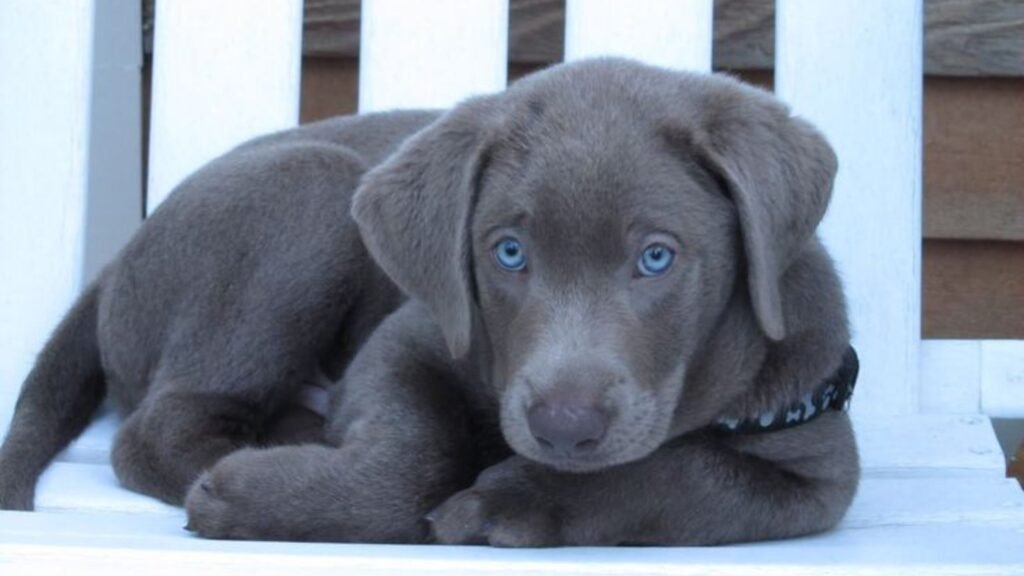
Champagne Labradors: The Lightest Dilute
The champagne Lab is the dilute form of yellow, characterized by an extremely pale, creamy coat.
- Genetic Basis: Genetically, they have the __eedd genotype (yellow with two recessive ‘d’ alleles).
- AKC Registration: The AKC registers champagne Labradors as ‘yellow.’
- Dilute Nature: The champagne Labrador dilute is less common but shares the same genetic basis as other dilutes.
- Health Consideration: Prospective owners should be aware of potential CDA.

Fox Red Labradors: A Shade of Yellow with a Unique Look
The fox red Lab is not a dilute color but a very dark, rich, intense shade of yellow.
- Genetic Basis: Genetically, they are ‘yellow’ (ee genotype) with additional modifier genes enhancing red pigment.
- Historical Significance: This striking color is reminiscent of earlier Labradors.
- AKC Registration: They are registered as ‘yellow’ by the AKC.
- Popularity & Temperament: The popularity of the dark yellow Lab or red Labrador has grown. There is no scientific basis that fox red Lab temperament differs from other yellow Labradors.

White Labradors: The Pale End of the Yellow Spectrum
White Labradors are genetically very light yellow Labradors, not a separate color. They are ‘yellow’ (ee genotype) with modifier genes significantly reducing the intensity of yellow pigment, causing them to appear almost pure white.
- Distinction: They are not albinos, possessing full pigment in eyes, nose, and paw pads.
- AKC Registration: Registered as ‘yellow’ by the AKC.
- Health & Temperament: Like the cream Lab or light yellow Lab, their pale coat is a variation within yellow, with no inherent health or temperament differences.

The Science of Shade: Genetics Behind Labrador Retriever Colors
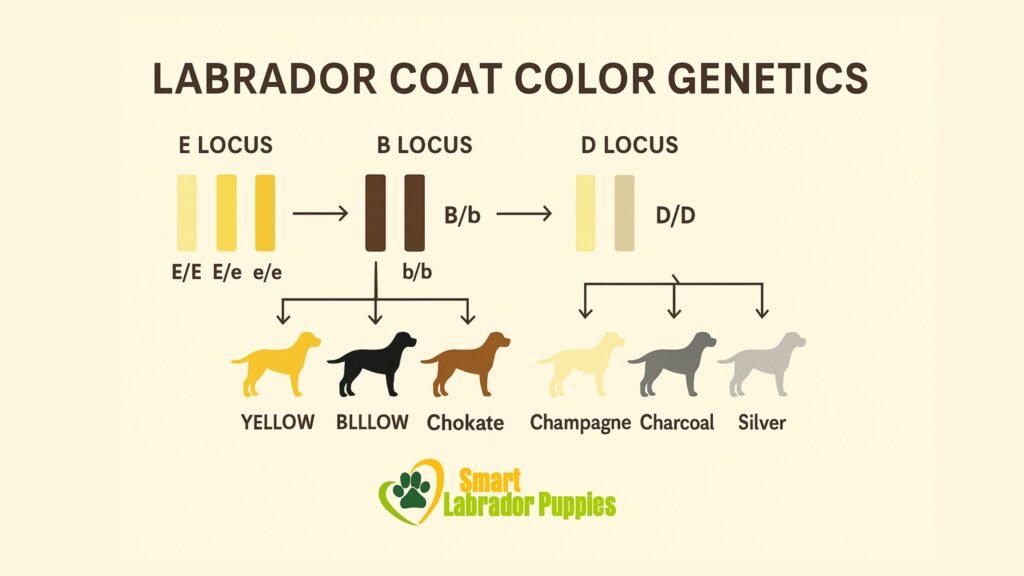
Understanding Labrador Retriever colors requires a basic grasp of canine coat color genetics. The array of hues seen in Labradors is primarily governed by the interaction of genes at the E, B, and D loci, dictating pigment type and intensity, offering insight into Lab coat color inheritance and Labrador DNA.
Understanding the E Locus: Extension Gene
The E locus (Extension gene) controls eumelanin (black/brown pigment) distribution. The dominant ‘E’ allele allows for full pigment expression; if a dog inherits at least one ‘E’ (EE or Ee), its color is then determined by the B locus. Two recessive ‘e’ alleles (ee) result in a yellow coat, regardless of B locus genotype, as ‘ee’ prevents black/brown pigment expression, allowing only red/yellow (pheomelanin) to show. All yellow Labradors share the ‘ee’ genetic makeup.
Understanding the B Locus: Black/Brown Gene
The B locus (Black/Brown gene) determines if eumelanin is black or brown. Its effect is visible only if the E locus allows eumelanin expression (not ‘ee’). Dominant ‘B’ produces black pigment (BB or Bb). Recessive ‘b’ produces brown (chocolate) pigment. For a Labrador to display chocolate coloration, it must inherit two ‘b’ alleles (bb) and at least one dominant ‘E’ allele. This interaction is fundamental to Labrador color genetics.
The Dilute Gene (D Locus) and Unofficial Colors
The D locus (Dilute gene) affects all pigment intensity. Dominant ‘D’ results in full pigment expression. Two recessive ‘d’ alleles (dd) cause dilution of the base color. This is the genetic basis for unofficial colors: black with ‘dd’ becomes charcoal Lab, chocolate with ‘dd’ becomes silver Lab, and yellow with ‘dd’ becomes champagne Lab. The dilute gene Lab is the source of these unique shades.
How Genes Combine to Create Every Color
The complex interplay between the E, B, and D loci ultimately dictates the final coat color:
- Black: B_E_D_ (at least one dominant ‘B’, ‘E’, and ‘D’).
- Chocolate: bbE_D_ (two recessive ‘b’, at least one dominant ‘E’ and ‘D’).
- Yellow: __eeD_ (two recessive ‘e’, at least one dominant ‘D’). Shade influenced by modifier genes.
- Charcoal: B_E_dd (genetically black, but ‘dd’ dilutes to charcoal).
- Silver: bbE_dd (genetically chocolate, but ‘dd’ dilutes to silver).
- Champagne: __eedd (genetically yellow, but ‘dd’ dilutes to champagne).
This genetic dance highlights the complexity of Labrador DNA, demonstrating how a few key genes produce diverse Labrador Retriever colors.
Do Labrador Retriever Colors Influence Temperament or Health?
A common misconception is that a Labrador Retriever’s coat color predicts its temperament or health. Scientific research largely debunks these myths, emphasizing other factors are far more influential. It’s crucial to separate anecdotal claims from evidence when considering Labrador color temperament and Lab color health issues.
Temperament Myths vs. Reality: Is There a ‘Best’ Color?
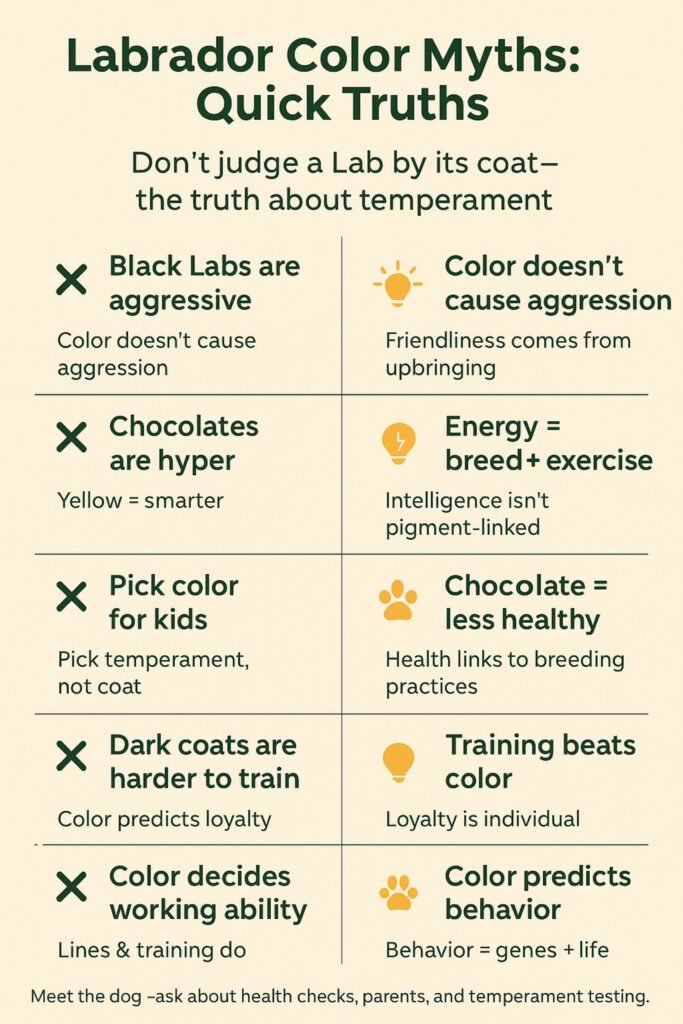
There is no scientific evidence that a Labrador’s coat color directly influences its personality. Claims like ‘black Labs are calmer’ or ‘chocolate Labs are more hyper’ are anecdotal.
- Temperament Factors: Temperament is a complex tapestry woven from genetic lineage, early socialization, and consistent training.
- Breeder Priority: Responsible breeders prioritize temperament regardless of color.
- Choosing Wisely: Seeking a ‘best’ Labrador color based on temperament is misguided; instead, focus on the individual dog’s lineage and early experiences.
Health Considerations Across Colors: Fact or Fiction?
Generally, a Labrador’s coat color does not inherently predispose it to specific health issues, with one exception for dilute colors. Overall health is overwhelmingly determined by responsible breeding, genetic screening, and quality care. Focusing on color as a health indicator is misleading.
- Overall Health: While some studies suggest minor statistical differences in longevity or certain conditions (e.g., for chocolate Lab health), these are generally less significant than comprehensive genetic health testing and overall breeding quality.
- Misconception: Attributing black Lab health problems solely to color oversimplifies canine well-being.
Dilute Colors and Potential Health Concerns (e.g., CDA)
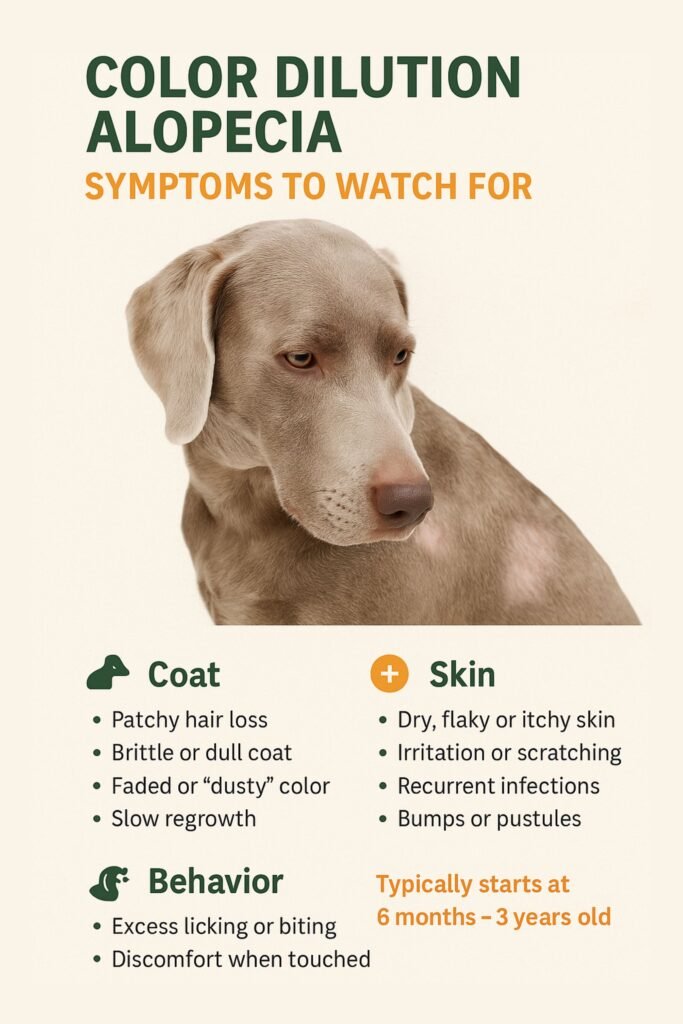
Dogs with the ‘dd’ genotype (dilute colors like silver, charcoal, and champagne) can be predisposed to Color Dilution Alopecia (CDA). CDA is a genetic disorder affecting hair follicles, causing thinning, breakage, and recurrent skin infections. This condition is a known genetic link associated with the dilute gene and is a legitimate health consideration for owners of dilute-colored Labradors. It’s the primary health concern directly linked to Labrador health by color, specifically for dilute varieties.
Choosing Your Labrador: Prioritizing Beyond Color
When embarking on the journey of choosing a Labrador Retriever, prospective owners should prioritize factors far more critical than coat color to ensure a healthy, well-adjusted, and long-lived companion. While visual appeal is undeniable, it pales in comparison to foundational elements that truly define a quality Labrador.
Focusing on Health, Temperament, and Reputable Breeders
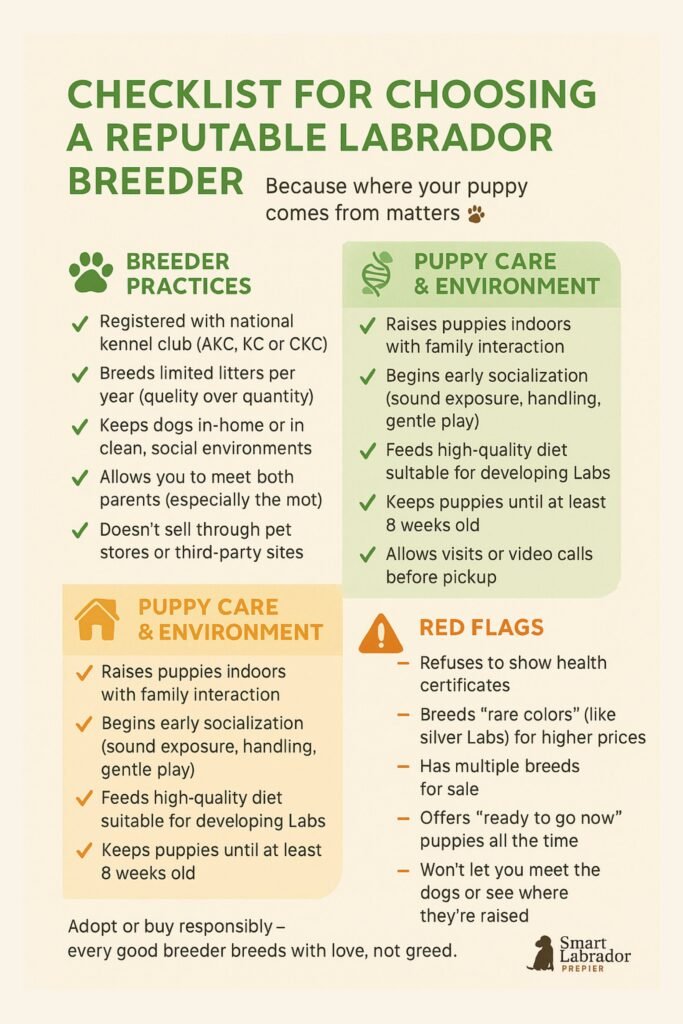
The most important considerations for Labrador puppy selection are its health, the proven temperament of its parents, and the unwavering reputation of the Labrador breeder.
- Breeder’s Role: A reputable breeder prioritizes the health and temperament of their breeding stock.
- Health Clearances: They conduct extensive health clearances for hip and elbow dysplasia, eye diseases, and cardiac issues.
- Transparency: Such a breeder will be transparent about pedigrees and provide insights into their lines’ typical temperament, ensuring puppies are well-socialized.
- Outcome: This approach to responsible Labrador ownership ensures you are bringing home a dog with the best possible start.
The Importance of Genetic Testing and Pedigree
Responsible breeders utilize Labrador health testing for common genetic diseases like Exercise-Induced Collapse (EIC), Centronuclear Myopathy (CNM), and Progressive Retinal Atrophy (PRA).
- Pedigree Review: Reviewing the puppy’s pedigree provides invaluable information about ancestors’ health, longevity, and working abilities.
- Reliable Indicators: These tools are far more reliable indicators of a puppy’s potential health and future Labrador temperament than its coat color.
- Long-Term Investment: By focusing on these critical aspects, you invest in a companion likely to be a joy for many years, regardless of its beautiful shade.
Conclusion: Embracing the Diversity of Labrador Retriever Colors
This comprehensive Labrador Retriever color guide has explored the full spectrum of Labrador coats, from the three official colors—black, yellow, and chocolate—to the fascinating dilute variations and intense shades like fox red and white. While the visual diversity of Labrador Retriever colors is captivating, it is crucial for prospective owners to look beyond aesthetics.
- There is no single “best Labrador color” in terms of health or temperament.
- The true essence of a Labrador lies in its health, its inherent temperament, and the responsible breeding practices that uphold the integrity of the Labrador breed standards.
- By prioritizing these fundamental aspects—health testing, proven temperament, and a reputable breeder—owners can ensure they bring home a loving, healthy companion, ready to enrich their lives, regardless of its beautiful hue.

Frequently Asked Questions
What are the official Labrador Retriever colors recognized by the AKC?
The American Kennel Club (AKC) officially recognizes three primary Labrador coat colors: black, yellow, and chocolate. These official colors include a wide range of shades, such as palest cream to fox red within yellow, and milk chocolate to dark liver within brown.
Do Labrador Retriever colors influence their temperament or personality?
No, there is no scientific evidence that a Labrador’s coat color directly influences its temperament or personality. Myths suggesting differences (e.g., “black Labs are calmer” or “chocolate Labs are more hyper”) are anecdotal. A Labrador’s temperament is primarily shaped by its genetic lineage, early socialization, and consistent training.
Are ‘dilute’ Labrador colors like silver, charcoal, or champagne officially recognized by the AKC?
No, ‘dilute’ colors such as silver, charcoal, and champagne are not officially recognized as distinct colors by the AKC. Instead, they are registered under their closest standard color; for example, silver Labs are registered as ‘chocolate,’ charcoal Labs as ‘black,’ and champagne Labs as ‘yellow.’ These colors result from a specific genetic dilute marker.
What is the genetic basis for the different Labrador Retriever coat colors?
Labrador Retriever coat colors are primarily determined by the interaction of genes at the E, B, and D loci. The E locus controls whether black/brown pigment is expressed (yellow if not), the B locus determines if the pigment is black or brown, and the D locus (dilute gene) affects the intensity of the pigment, leading to dilute colors like silver, charcoal, or champagne when two recessive ‘d’ alleles are present.
Are there any specific health concerns linked to certain Labrador Retriever coat colors?
Generally, a Labrador’s coat color does not inherently predispose it to specific health issues, with one notable exception. Dogs with the ‘dd’ genotype (dilute colors like silver, charcoal, and champagne) can be predisposed to Color Dilution Alopecia (CDA), a genetic disorder that affects hair follicles, causing thinning, breakage, and recurrent skin infections.